This article is about what the research says. The church’s part, and how a church leads people toward devotion, is in The main thing: is your church doing its part?
Even regulars come about twice a month
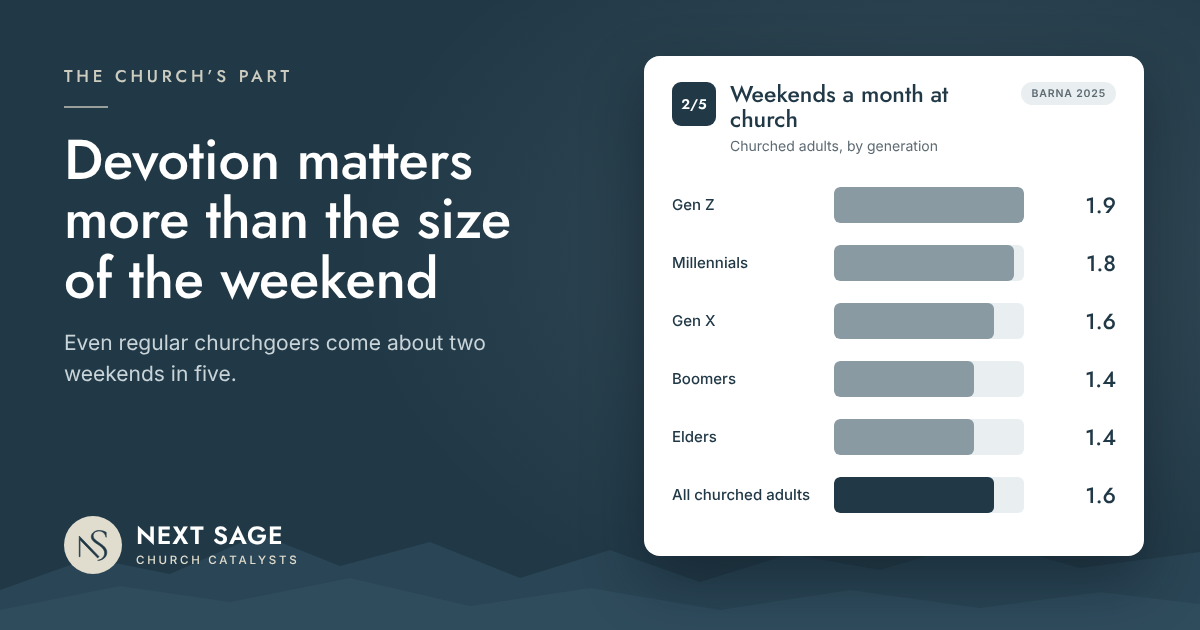
Barna’s 2025 State of the Church research found that adults who attend church go, on average, 1.6 times a month. That’s about two weekends in five, and these are people who call a church home.
Across all adults, the numbers are lower. In Gallup’s 2025 data, 31% of Americans attended religious services weekly or nearly weekly, and 57% said they seldom or never go.
So a church’s regulars are likely in the room about half the time. A weekend count is a snapshot of whoever happened to come that Sunday.
The picture is steady, not collapsing
None of this means the church is disappearing. Pew’s Religious Landscape Study, the largest survey of its kind, found the Christian share of U.S. adults has stayed between 60% and 64% since 2019. The share who attend at least monthly has held at about a third.
Young adults are the open question. Barna found Gen Z and Millennial churchgoers went from about one weekend a month in 2020 to nearly two in 2025. Gallup’s numbers point the other way: 25% of adults under 30 attend weekly or almost weekly, compared with 37% of adults 65 and older. Researchers don’t agree yet.
Attendance isn’t devotion
Barna’s CEO, David Kinnaman, put the central point plainly: “churchgoing alone does not in itself create devoted disciples.” Even when attendance rises, it doesn’t tell a church whether people are becoming more devoted to Jesus.
The weeks between churches
Lifeway Research’s 2023 Church Switchers Study looked at people who have changed churches as adults. Of those, 41% stopped attending church for more than three months before settling in a new one, up from 28% in 2006.
And people decide quickly. Seven in 10 decide to keep attending their new church after three visits or fewer.
What it means for a church
Three things follow from the research. None of them tells a church what program to run.
- A weekend count measures less than it used to. When a regular attends twice a month, the size of any one Sunday says more about the calendar than about the church.
- What holds people is what happens between Sundays. Someone in a group, on a team or near a leader who notices them is still connected on the weekends they miss.
- The first few visits carry more weight than ever. Most people decide within three visits, and a growing share go months between churches.
The size of the weekend still matters. It’s people. But it can’t tell a church whether those people are moving toward devotion to Jesus, and that’s the main thing.
Related reading: The main thing: is your church doing its part? · The role of data in leading people toward devotion to Jesus
Sources: Barna Group and Gloo, State of the Church 2025 (September 2025) · Gallup, Americans’ Religious Engagement Holds at Lower Levels (2026) · Pew Research Center, 2023–24 Religious Landscape Study (February 2025) · Lifeway Research, Church Switchers Study (2023)
We bring experienced church leadership and your church’s own data together to build your Season Plan. If you’d like help with this, apply to be a Founding Client or request a 45-minute Discovery Meeting.