When we talk about a church growing, we can mean people becoming more like Jesus. But often we just mean more people attending. We say, “That church is really growing,” and what we mean is that there are more people there on Sunday.
I’ve served in and alongside churches for 41 years, from 250 people to more than 20,000. I’ve seen churches, big and small, where people often shared about their life change, and sadly, churches of all sizes where the church wondered whether life change was taking a back seat to the size of the weekend. The size of the weekend was never the main thing.
The mission is clear
The mission of the church is to help people become followers of Jesus and to help them become more like him. That change is internal, and it shows up in how a person lives. Faith and deed. It’s nearly impossible to measure, but easy to see in a life.
Luke describes the first church in one phrase: “They devoted themselves” (Acts 2:42). That’s still the point. Not a bigger room. More people devoted to Jesus.
Three parts, and only one is ours
I once heard it put this way: God is always doing his part to draw people to him and help them become more like Jesus, and they definitely have a part to play, but there is also our part. The church’s part.
Paul said the same thing about his own ministry: “I planted, Apollos watered, but God gave the growth” (1 Corinthians 3:6). And Luke closes his picture of that first church with God’s part, not theirs: “the Lord added to their number day by day” (Acts 2:47).
That takes a weight off. We can’t produce devotion in anyone. We can’t do the person’s part for them, and we were never asked to do God’s. But the church’s part is real, and it’s ours.
How it happened for me
My own faith was shaped one conversation at a time. It started with weekly breakfasts with people in my life like John Erickson and Bill MacPhee. They showed me how to live a life devoted to Jesus by investing in me.
When I tell that story, the most common response I get is “me too.” People share the story of a John or a Bill and what that person meant in their becoming devoted to Jesus.
You can’t schedule that. You can make room for it.
The church’s part, in four steps
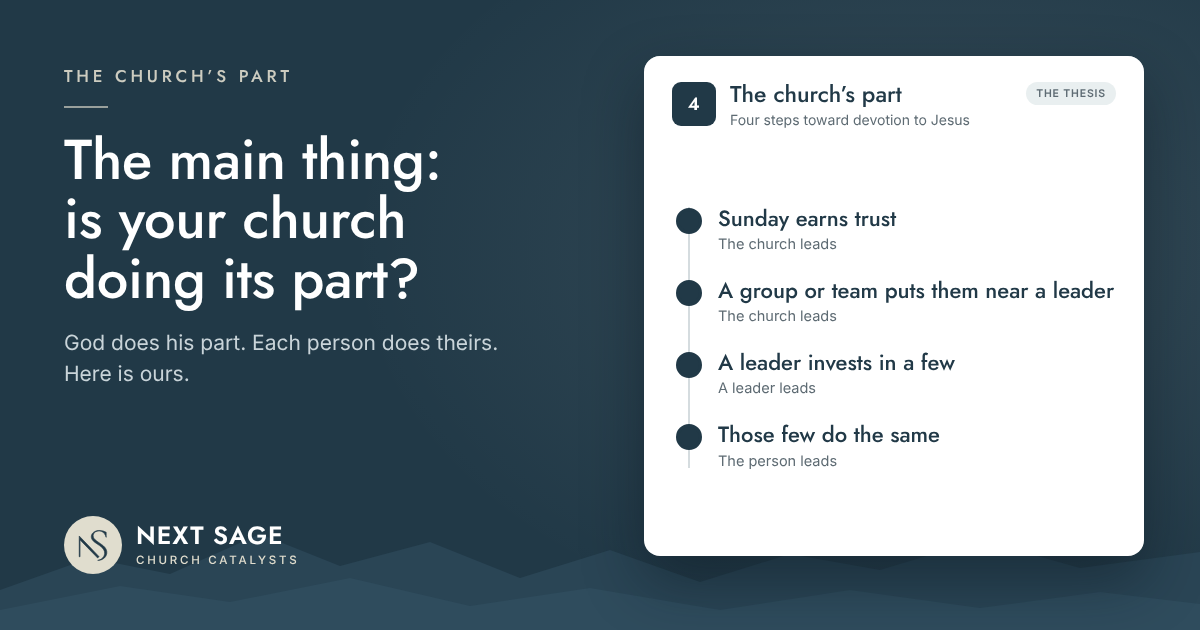
When I look at how that happens across churches of every size, I see four steps:
- Sunday earns trust. The church meets people where they are and gives them a reason to come back.
- A group or a team puts them near a leader. Not only to run a meeting or finish a task, but to notice people.
- A leader invests in a few. One to three people, over time, in conversation.
- Those few do the same. This is where new leaders come from.
The church leads the first two. A leader leads the third. The person leads the fourth. Paul packed all four generations into one sentence to Timothy: what you heard from me, “entrust to faithful men, who will be able to teach others also” (2 Timothy 2:2).
Why the third step is never counted
Not everyone in a group or on a team needs that kind of investment. Some aren’t ready. Some already have a deep faith. Some aren’t a fit for that particular leader. A few are. So there’s no ratio to hit, and no one should try to schedule it.
What a church can do is put people near more leaders. A person near two leaders has better odds of finding the one who will invest in them than a person near one.
So, is your church doing its part?
Every pastor knows how people become devoted to Jesus, because it happened to them. What’s harder is seeing whether the church is making room for it. Here’s what a church can actually see at each step, and what it can’t:
- Sundays: who comes, how often, who’s new and who has drifted. Not why.
- Groups and teams: how many people have moved from the room into a group or a team, and how fast. Not whether they feel known.
- Leaders: whether leaders are themselves being led, how long they stay and how many people each one carries. Not who they invest in.
- New leaders: whether they’re coming from inside groups and teams. Not what moved them.
None of that measures faith, and nothing ever should. No person gets a score. But taken together, it answers the question that matters most for the church’s part: are people moving from a first Sunday toward a place where someone can invest in them?
If you can answer that honestly, you’ll know where to start. Usually it’s two or three things, not twenty.
Related reading: Why we chose the words we did · Why a dashboard can help you lead more people toward devotion
We bring experienced church leadership and your church’s own data together to build your Season Plan. If you’d like help with this, apply to be a Founding Client or request a 45-minute Discovery Meeting.