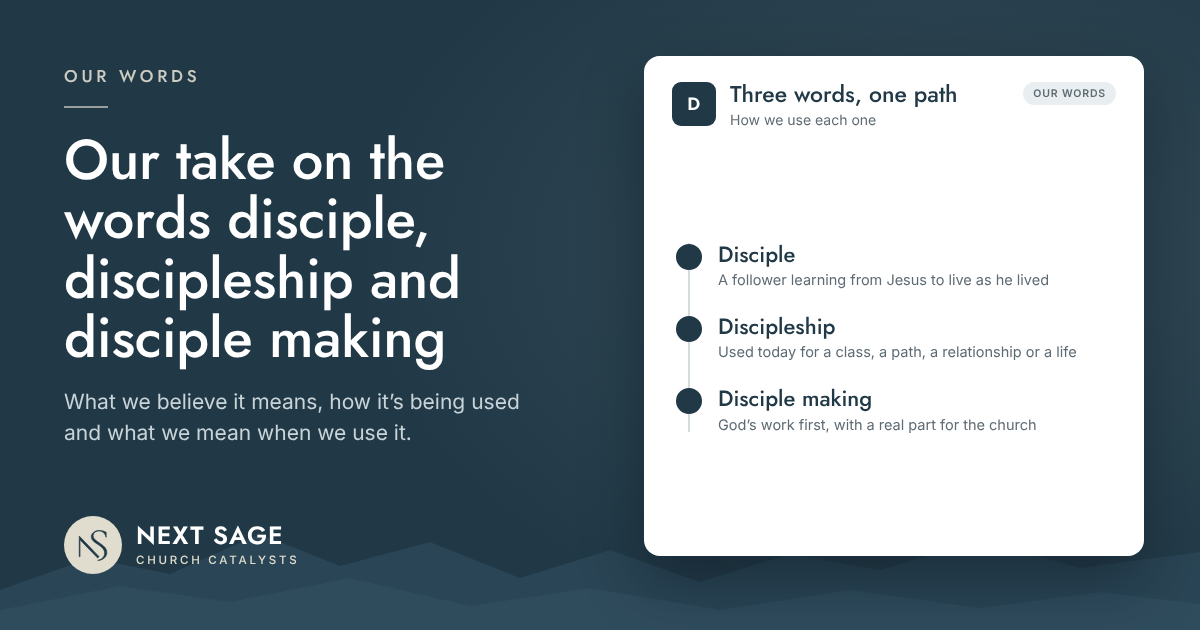
In Why we chose the words we did, I said we use “disciple,” but only when we say what we mean by it. This article is our take on that word and the two that grew from it: discipleship and disciple making.
In Scripture
The Greek word is mathētēs. At its root it means a learner or an apprentice: someone who learns by being with their teacher, not just by hearing them. It appears 261 times in the New Testament, every one of them in the Gospels and Acts.
That pattern is worth noticing. In the Gospels, a disciple is someone who follows Jesus in person. After Acts, the letters use other words for the same people, such as “saints” and “brothers,” and Acts shows the change happening. It’s also in Acts that “the disciples were first called Christians” (Acts 11:26).
Three verses shape what the word asks of a person:
- It’s about becoming like the teacher. “Everyone when he is fully trained will be like his teacher” (Luke 6:40).
- It’s costly. “Whoever does not bear his own cross and come after me cannot be my disciple” (Luke 14:27).
- It’s the church’s charge. “Go therefore and make disciples of all nations” (Matthew 28:19).
In history
The early church took becoming a follower seriously. By the third century, one early church order set three years of instruction before baptism, and added that a person’s conduct, not the length of time, was what decided it. What mattered was a changed life.
Over the centuries the word has kept being recovered. John Wesley gathered early Methodists into classes of about twelve, where people asked each other how their souls were doing. In 1937, Dietrich Bonhoeffer wrote a book whose German title simply means “following.” It’s known in English as The Cost of Discipleship. And Dallas Willard described a disciple as an apprentice to Jesus, learning from him how to live his life the way he would live it.
In churches today
Ask five churches what “discipleship” means and you may hear five answers:
- A class: a course someone completes.
- A program or pathway: a series of steps a church lays out.
- A relationship: one person investing in another.
- A stage: something after becoming a Christian.
- A whole life: everything it means to follow Jesus.
None of these is wrong, but they aren’t the same thing. When a church says it wants to “make disciples,” people in the same room may picture very different things.
Disciple making
Jesus’ charge was to “make disciples” (Matthew 28:19), and many churches call their work disciple making. We believe it’s God’s work first. Paul put it plainly: “I planted, Apollos watered, but God gave the growth” (1 Corinthians 3:6). Each person has a part too: choosing to follow and to keep learning.
And the church has a real part. It makes room for people to be noticed and invested in, one conversation at a time. That’s why we talk about catalysts, not programs. A church can make disciple making more likely. It can’t manufacture it.
What we mean when we use it
Here’s the definition we work from:
A disciple is a follower of Jesus, learning from him to live as he lived. It’s an inward change, and it shows in spiritual practices and in how a person lives.
That puts us closest to Scripture’s own meaning: a learner, becoming like the teacher, in a way you can see in a life.
It also explains how “disciple” fits with the words we use most. “Disciple” names the person on the path. “Devoted to Jesus” names where the path leads. And the church’s part is to make room along the way for people to be noticed and invested in, which is what disciples have always needed.
Related reading: Why we chose the words we did · The main thing: is your church doing its part?
Sources: Emmaus Bible College, “Disciple” in the New Testament (2022) · Hastings’ Dictionary of the New Testament, “Disciple” · Hippolytus, Apostolic Tradition (c. 215)
We bring experienced church leadership and your church’s own data together to build your Season Plan. If you’d like help with this, apply to be a Founding Client or request a 45-minute Discovery Meeting.